According to Crunchbase, global VC hit $425B in 2025, up 30% year-on-year. The median seed pre-money valuation was $18.4 million in Q1 2026. Down rounds reduced to 11.4% in Q1 2026, comparable to 2019-20 levels. By every headline metric, the venture market has rebounded from the 2022-23 correction.
But most founders raising right now are not experiencing that market.
The headline numbers are real, they are just concentrated. AI has captured the majority of venture dollars, late-stage rounds dominate capital flows, and the median most founders benchmark against reflect that reality, not theirs.
This article works through the numbers layer by layer: what the market actually looks like right now, what founders are raising at by stage and sector, and what the fundraising price the preferred share price investors pay actually implies for the equity underneath it.
Table of Contents
Key Takeaways
- The recovery is real but concentrated. 88.8% of VC deal value in Q1 2026 went to AI companies. Global VC hit $425B in 2025, but for non-AI founders the market feels tighter than the headlines suggest because it is.
- The benchmark you are using is probably wrong. The Q1 2026 Series A median pre-money is $62M. That figure includes AI deals. Non-AI companies sit at $42.4M, about 32% lower. Pricing against the wrong cohort is one of the most common and costly mistakes founders make.
- Stage medians hide more than they reveal. Series A and Series B numbers look strong in aggregate. But seed-to-A conversion has dropped from 50% to 38%, and the average time between rounds has stretched to 616 days. The path between stages is longer and narrower than it was.
- Geography changes everything at an early stage. 90.9% of Q1 2026 VC deal value went to Bay Area, New York, LA, and Boston. If you are not in a major U.S. hub, the headline numbers do not apply to you.
How Startup Valuations Have Changed Since 2021
To properly read the current figures, you must first understand the arc that produced them.
In 2021, capital flooded the market. Multiples were inflated, FOMO reduced deal timelines from months to weeks, and founders who raised at peak prices set expectations the market could not meet. According to Crunchbase, global VC hit $681 billion that year.
The 2022-23 correction was significant. Down rounds exceeded 20% of all rounds at the peak, according to Cooley. Pre-money valuations reset across most stages. According to Crunchbase, global VC deal volume declined from $681 billion in 2021 to $304 billion in 2023.
The recovery is not broad-based. It is AI-led, AI-concentrated, and in large part AI-explained.
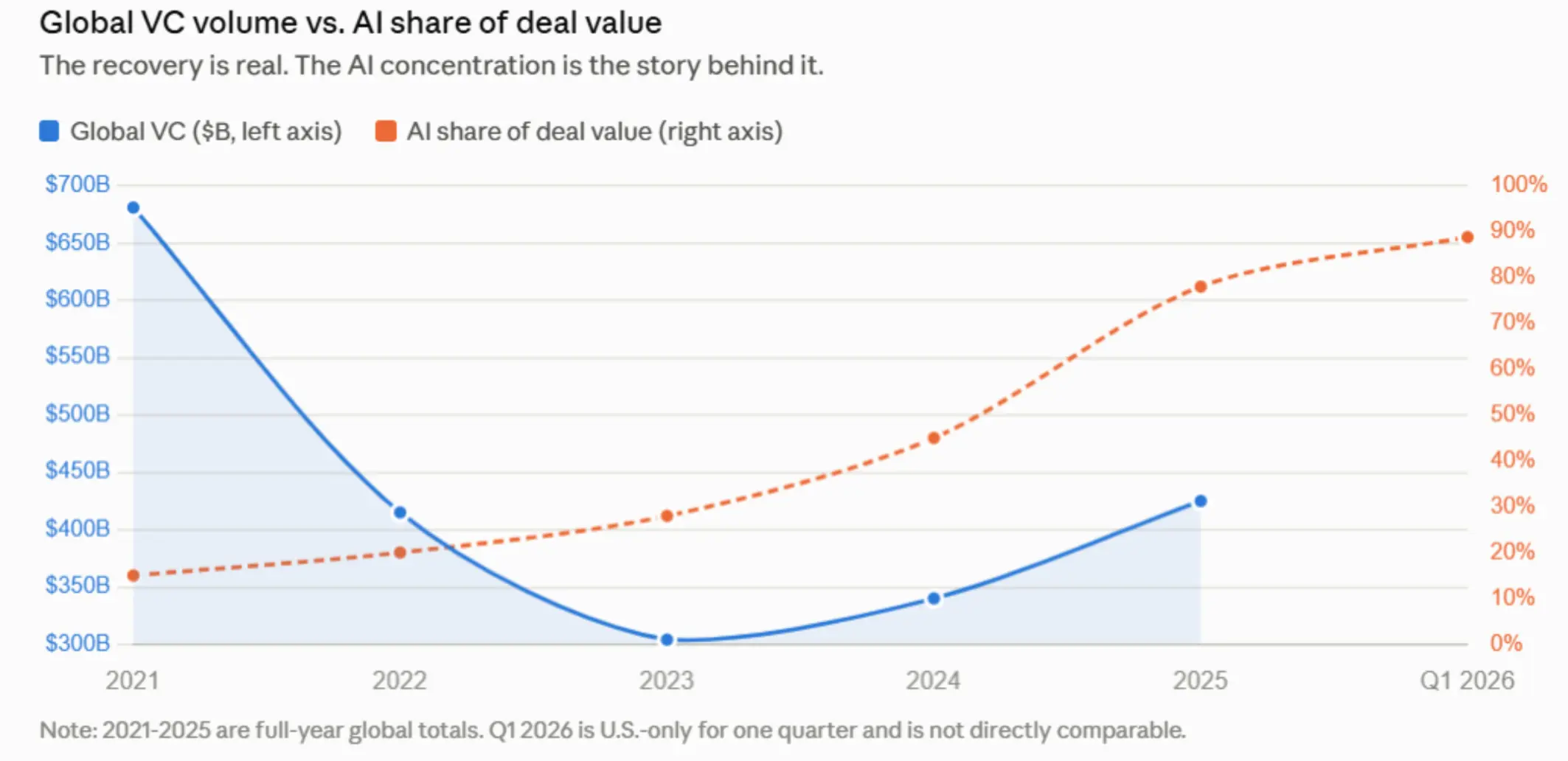
According to PitchBook-NVCA, AI companies captured 88.8% of all VC deal value in Q1 2026, while accounting for 42.5% of deal count, a small number of very large rounds doing most of the work. VC volume fell sharply in 2022-23, then recovered, but the rebound is almost entirely explained by AI concentration, not a broad-based return of capital.
VC market at a glance: 2021 to Q1 2026
| Year | Global VC ($B) | Median Seed Pre-Money | Median Series A Pre-Money | AI Share (deal value) | Down Round Rate |
| 2021 | $681B (global) | $9M | $21M | 15% | 8% |
| 2022 | $415B (global) | $8M | $20M | 20% | 20%+ |
| 2023 | $304B (global) | $7M | $18M | 28% | 20%+ |
| 2024 | $340B (global) | $13M | $39.7M | 45% | 15% |
| 2025 | $425B (global) | $15.8M | $46.5M | 78% | 12% |
| Q1 2026 (U.S. only) | $267.2B | $18.4M | $62M | 88.8% | 11.4% |
* Q1 2026 ($267.2B) is U.S.-only for one quarter and is not directly comparable to annual global figures.
Sources: PitchBook-NVCA Venture Monitor Q1 2026 · Cooley Venture Financing Report Q1 2026 · Crunchbase 2025-2026 · CB Insights
Global VC volume vs. AI share of deal value
What Is the Median Startup Valuation at Seed Stage in 2026?
According to the PitchBook-NVCA Q1 2026 Venture Monitor, the median seed pre-money valuation has risen to $18.4 million in Q1 2026, more than double the figure from 2021. The median seed deal size stood at $3.0 million. That number needs immediate context.
The same report shows that if you exclude the five largest deals in Q1 2026, total deal value falls by 73.2%. Q1 2026 marked a new extreme in concentration. The headline valuation median reflects a market in which a small number of companies are vastly outraising the rest.
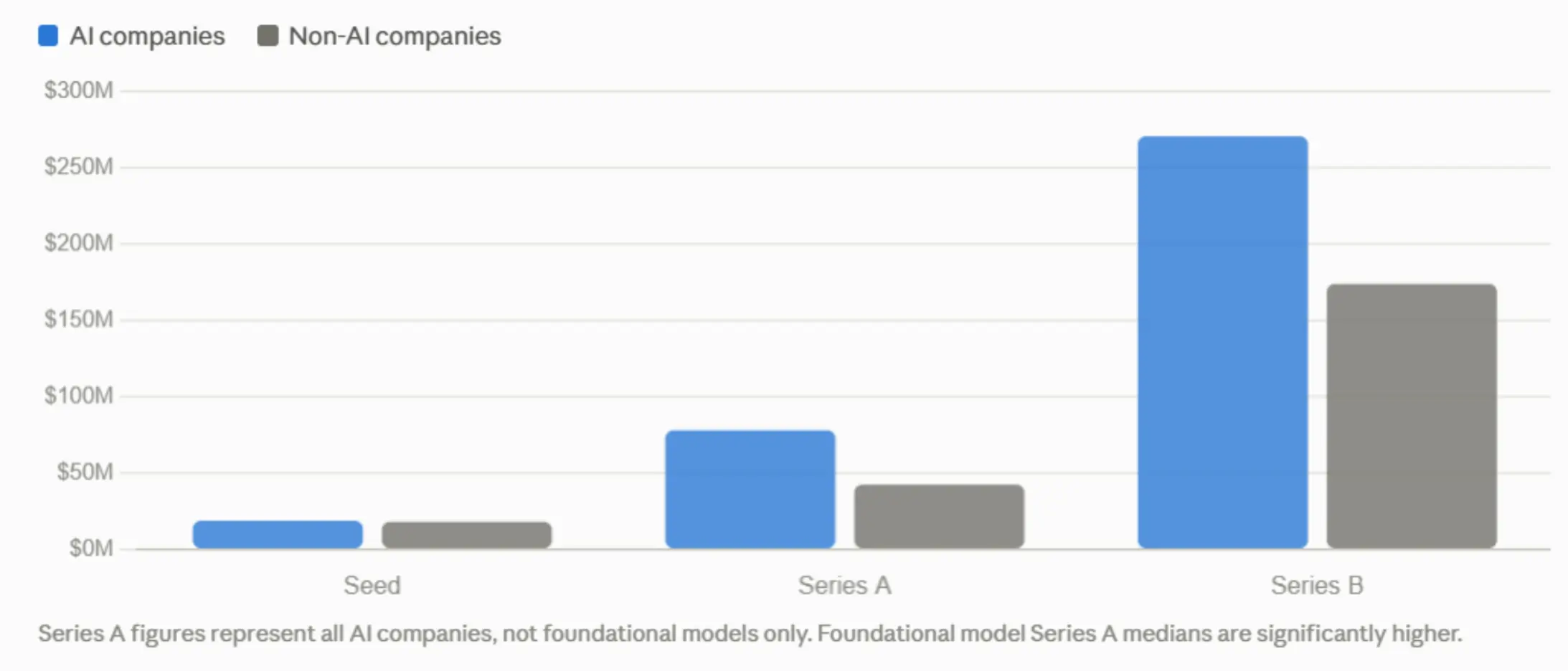
The AI split makes this clearer. AI companies carried a median seed pre-money valuation of $18.7 million in Q1 2026 versus $18.0 million for non-AI companies at seed. The gap widens sharply at Series A, where AI companies sit at $78 million versus $42.4 million for non-AI, and at Series B, where AI companies reached $270.8 million versus $174.0 million for non-AI.
Two other things the seed median does not show:
In 2025, 14 seed or pre-seed deals exceeded $100 million, according to the NVCA Yearbook. Remove the mega-deals and the rest of the market averaged $7.1 million per deal, comparable to 2019 or early 2020.
90.9% of VC deal value in Q1 2026 went to companies in Bay Area, New York, Los Angeles, and Boston hub markets. Founders outside those hubs are operating in a materially different funding environment.
The $18.4 million figure is real. For most non-AI founders outside major U.S. hubs, it is still the wrong number to benchmark against.
What Valuations Actually Look Like by Stage
The table below shows current median pre-money valuations, round sizes, and dilution ranges by stage. The commentary explains what each number means in practice.
| Stage | Median Pre-Money | Round Size | Dilution | Key signal |
| Pre-Seed | 30-40% below U.S. peers in Europe | $1M | 10-15% | Geography gap widest here |
| Seed | $18.4M (Q1 2026) | $3.0M | 20% | Top decile AI-inflated |
| Series A | $62M (Q1 2026) | $19.6M | 15-25% | ARR floor rising: $1-2M |
| Series B | $165M (Q1 2026) | $38-40M | 10-20% | High sector divergence |
Sources: PitchBook-NVCA Q1 2026 · Cooley Q1 2026 · PitchBook European VC Report
Pre-Seed
Pre-seed is the stage where the geography gap is widest. European startups at equivalent stages price 30-40% below U.S. peers, a gap that has widened as AI mega-deals concentrate in U.S. hubs. Founders raising outside major U.S. hubs Europe, Southeast Asia, Latin America should benchmark against regional figures, not the U.S. median. Using the wrong benchmark leads to overpriced rounds that are harder to close.
Seed
The $18.4M median is an all-time high. But it is being pulled upward by AI deals at the top decile. Non-AI seeds sit at $18.0M at the median, a 4% difference that understates the real story. Strip out mega-deals entirely and the non-hub, non-AI market looks considerably different. A founder benchmarking against the aggregate $18.4M without accounting for this is likely mispricing their round.
Series A
The traction bar has risen significantly. The informal ARR floor for non-AI companies is now $1-2M. Average time from seed to Series A has stretched to 616 days, and seed-to-A conversion has dropped from 50% to 38%. A seed round today is not a guaranteed path to a Series A. It is a path to a chance at one.
Series B
This is where sector divergence is most pronounced. AI infrastructure companies and non-AI SaaS companies at Series B are effectively in different markets. Cooley Q1 2026 shows the Series B median pre-money at $165M down from $195M in Q4 2025. AI companies reached $270.8M versus $174.0M for non-AI. Benchmarking by stage alone at this level is not useful. Benchmark by sector and comparable revenue multiple.
What a Valuation Actually Commits You To
The most important context a founder can have going into a 2026 raise: the headline valuation medians are an average of two very different markets. AI companies and non-AI companies are both included in the figures the founders benchmark against. They should not be.
AI vs. Non-AI Valuation Split by Stage (Q1 2026)
| Stage | AI Median Pre-Money | Non-AI Median Pre-Money | Premium |
| Seed | $18.7M | $18.0M | 4% |
| Series A (foundational model) | $300M+ | $42.4M | Material |
| Series A (applied AI / SaaS) | $78.0M | $42.4M | 84% |
| Series B | $270.8M | $174.0M | 56% |
Sources : PitchBook-NVCA Q1 2026 Venture Monitor
AI vs. non-AI pre-money medians by stage (Q1 2026)
The gap is small at seed. It becomes significant at Series A and B.
- 88.8% of all VC deal value in Q1 2026 went to AI companies
- 83% of SaaS capital in Q1 2026 went to AI startups
- The premium holds only where a real moat exists: proprietary model, defensible data, or distribution. Not an AI label.
Why this matters for your round
The $18.4M seed pre-money median includes all deals. Non-AI seeds sit at $18.0M at the median close to the headline, but the real gap appears when you strip out mega-deals and non-hub companies.
An overpriced seed is not just a negotiation problem. It embeds growth milestones into the next round that the business may not be able to hit.
What Is Driving Startup Valuations in 2026
Two sets of forces are pulling in opposite directions. Understanding both tells you which market you are actually operating in.
What is pushing valuations up
- $307.8B in U.S. VC dry powder entering 2025 capital that must be deployed
- 86% of Q1 2026 deals were up rounds; 42% had pre-money above $100M
- IPO window reopening exit visibility improves late-stage investor appetite
- AI competition among VCs is compressing deal timelines on hot deals
What is holding non-AI deals range-bound
- Seed-to-Series A conversion dropped from 50% to 38%
- Average time between seed and Series A: 616 days
- Seed deal volume down 9% YoY in North America despite higher prices
- 68% of North American VC going to late-stage less capital reaching early stage
Your valuation sets the bar for the next round
A valuation is not just a price. It is a growth contract. The multiple you accept today embeds the milestones required for the next round. An $18.4M pre-money seed on a $3.0M raise implies a Series A in the $50-80M range which requires a business that can credibly show the ARR, growth rate, and burn multiple to support that trajectory.
- ARR growth rate, burn multiple, NRR: the metrics investors underwrite to now, not just at Series A
- The informal Series A ARR floor for non-AI companies has risen to $1-2M
- A high valuation is a liability as much as an asset it sets a bar that must be cleared at the next raise
The geography gap
90.9% of Q1 2026 VC deal value went to companies in Bay Area, New York, LA, and Boston. European startups at equivalent stages are priced 30-40% below their U.S. peers, a gap that has widened as AI mega-deals concentrate in U.S. hubs.
| Region | Seed Median (approx.) | Gap vs. U.S. hub markets |
| US (hub markets) | $18.4M | Baseline |
| Europe | 30-40% below U.S. peers | 30-40% below |
| Outside U.S. hub markets | 53.9% of pre-seed/seed deal count;
54% of deal value |
25-35% below |
Sources: PitchBook-NVCA Q1 2026 · PitchBook European VC Report
Where This Goes in H2 2026
Looking ahead to H2 2026, the AI label premium will compress the moat premium and survive, but the label alone will not. The IPO pipeline, with potential listings from SpaceX, OpenAI, and Anthropic, could reshape late-stage appetite significantly. For non-AI founders, valuations are likely to remain range-bound without a macro catalyst. A down-round spike is unlikely the 2022-23 hangover has cleared and most companies that needed to reset have done so.
How Founders Should Benchmark Their Startup Valuation
The market has recovered. But the recovery is not evenly distributed, and the numbers most founders are using as benchmarks are not the numbers that apply to them.
Three things matter most going into a raise in 2026:
Benchmark against your actual cohort. If you are a non-AI company raising a Series A, your comp set is not the aggregate $62M median. The non-AI median is $42.4M and if you are outside a major U.S. hub, it is lower still. Price accordingly.
Understand what your valuation implies for the next round. A high valuation today sets milestones that must be hit in 18-24 months. Model the ARR, growth rate, and burn multiple that your next round will require before you agree to the current one.
Your 409A FMV is not the same number as your preferred round price. The 409A not the round price is what sets option strike prices and determines QSBS eligibility. Get it done within 90 days of closing.


![12 Best Startup Financial Model Templates [Free & Paid]](https://d1pnnwteuly8z3.cloudfront.net/images/177302d9-3657-45b7-ac9d-acf801d83a74/019fadd2-2388-77a4-a43e-6c44f536d546.jpg)